
Building quality backlinks is an important part of a long-term SEO strategy. However, successful link building is not about collecting as many links as possible. It is about finding relevant websites, creating genuine value, and building relationships that can improve your website’s authority and organic visibility.
In this guide, we will explore a practical backlink-building strategy based on keyword research, content analysis, prospect selection, and personalized outreach. The process is designed to help businesses, marketers, and website owners build relevant backlinks without relying on spammy tactics or paid link schemes.
Why Are Backlinks Important for SEO?
Backlinks are links from other websites that point to your website. When relevant and trustworthy websites link to your content, they can help search engines discover your pages and understand their relevance and credibility.
Quality backlinks can support SEO in several ways:
- Improve search visibility: Relevant backlinks can contribute to stronger organic search performance.
- Build website authority: Links from reputable websites can strengthen your site's credibility within its niche.
- Generate referral traffic: Visitors may discover your website through links in relevant articles.
- Support long-term growth: Valuable content can continue attracting links and visitors over time.
However, backlinks alone do not guarantee higher rankings. Their value depends on factors such as relevance, editorial context, link quality, and the overall quality of your website.
Understanding the Backlink Research and Outreach Process
An effective backlink-building strategy consists of two core activities: content research and targeted outreach.
Content research involves identifying existing articles, resource pages, and blog posts where a link to your website would genuinely help readers.
Targeted outreach involves finding the right people behind those pages and explaining why adding your resource would improve their content.
Combining these activities creates a repeatable link-building workflow. Instead of contacting random websites, you focus on relevant opportunities where your content offers a clear benefit.
Part 1: Backlink Research and Prospecting
Step 1: Identify Your Target Keywords
Start by identifying the topics, products, services, and problems associated with your business. These keywords will help you discover websites and articles that may be relevant backlink prospects.
Organize your keywords into three main categories:
- Audience and industry: The roles, industries, and interests of your target audience.
- Competitors: Alternative products, competing services, and websites operating in your niche.
- Products and solutions: The features, services, and problems your business addresses.
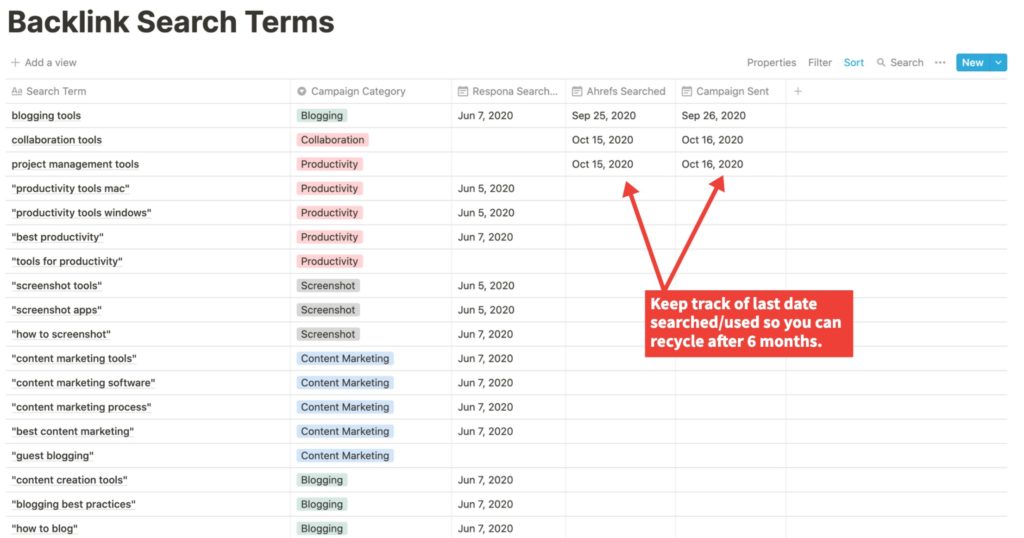
For example, a screenshot and image annotation tool might target keywords such as screenshot tools, productivity software, visual collaboration, image annotation, and PDF markup.
Your keyword list does not need to be perfect from the beginning. Start with the most relevant terms, then expand it as you discover new topics and opportunities.
Keep your keywords organized in a spreadsheet or project management tool. Record which terms you have researched to avoid repeating the same work.
Step 2: Turn Keywords Into Search Phrases
Once you have your initial keyword list, transform those terms into specific search phrases that reveal potential backlink opportunities.
The goal is not simply to find keywords with high search volume. Instead, you want to discover existing content where your website or resources would fit naturally.
For example, a productivity software company could explore search phrases such as:
- Best productivity tools
- Project management tips
- Tools for remote teams
- Software recommendations for small businesses
- Ways to improve team collaboration
These searches can reveal listicles, educational articles, industry guides, and resource pages that may be suitable for outreach.
You can also combine your primary keywords with terms such as “best tools,” “tips,” “guide,” “resources,” and “alternatives” to uncover additional opportunities.
The key is relevance. A smaller list of highly relevant articles is often more useful than thousands of unrelated pages.
Step 3: Choose the Right Content for Backlinks
There are two main approaches to backlink prospecting: earning links to your homepage and earning links to specific content on your website.
Homepage backlinks
These links are appropriate when an article discusses products, services, or tools that your business provides.
For example, an article about the best tools for product managers might naturally reference a screenshot annotation platform if it helps readers communicate ideas more effectively.
Content backlinks
These links point to a specific blog post, research report, tutorial, or resource on your website.
For instance, an article about blogging strategies could reference your detailed guide to creating blog graphics if the resource adds useful information for readers.
Listicles and resource roundups can be useful starting points because they already introduce multiple tools, recommendations, or resources. However, do not assume every listicle is a suitable prospect. The article must match your product or content and provide a legitimate reason for including your link.
Step 4: Build a Qualified Backlink Prospect List
After identifying your keywords and content opportunities, create a list of websites worth contacting.
SEO tools such as Ahrefs and Moz can help you discover relevant articles, analyze referring domains, and evaluate backlink opportunities.
A practical prospecting workflow looks like this:
- Select a keyword from your research list.
- Search for articles that discuss the topic directly.
- Review the results to identify relevant websites and pages.
- Evaluate the site's topical relevance, credibility, and existing content quality.
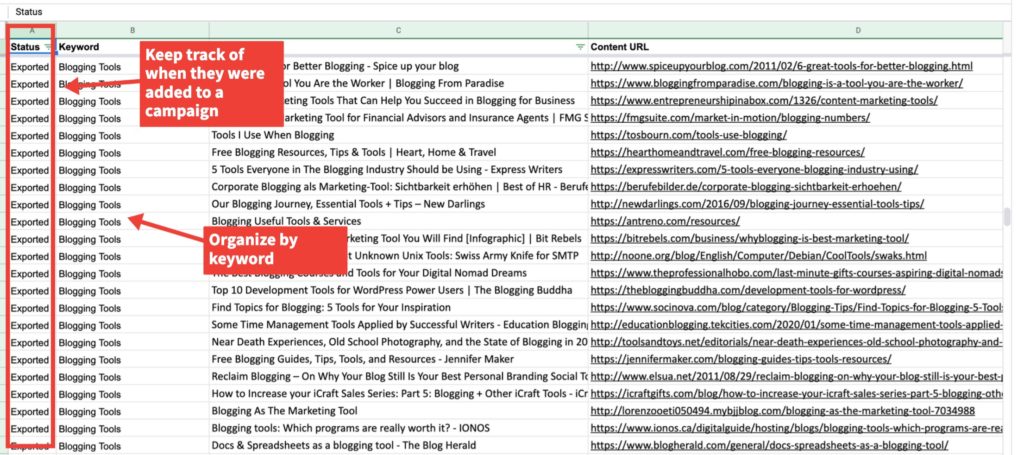
- Export suitable URLs into a spreadsheet.
- Record the article title, target URL, relevant keyword, contact details, and outreach status.
Domain Rating and similar metrics can help you compare websites, but they should not be the only selection criteria. A relevant link from a trusted website in your niche may be more valuable than a link from a higher-metric website with little topical connection.
Before adding a prospect to your list, check whether the article is current, whether your resource would improve it, and whether the website appears to maintain genuine editorial standards.
Start with a manageable batch of prospects rather than trying to contact thousands of websites at once. This makes personalization, quality control, and follow-up easier.
Part 2: Backlink Outreach Strategy
Once your prospect list is ready, the next step is to contact website owners, editors, or content managers.
The most effective outreach explains why the proposed link is relevant to their existing content. Rather than asking for a backlink without context, show how your resource could help their audience.
Step 5: Find the Right Contact Person
Finding the appropriate contact can take time, but it improves the relevance of your outreach.
Look for website editors, content managers, blog owners, or authors responsible for the article you want to reference.
Tools such as Snov.io and Respona can help streamline contact discovery and outreach management. You can also use the website's contact page, editorial team page, or publicly listed professional profiles.
Before contacting anyone, review your prospect list again. Remove irrelevant pages, duplicate URLs, job listings, technical documents, and other pages where a backlink request would not make sense.
Prioritize contacts who are directly connected to the content rather than sending generic messages to unrelated addresses.
Step 6: Write Personalized Backlink Outreach Emails
Your outreach email should be concise, professional, and relevant to the recipient.
A useful email typically includes:
- A personalized greeting.
- A brief reference to the article.
- A clear explanation of why your resource is relevant.
- A specific and reasonable request.
- A polite closing.
Avoid lengthy introductions and exaggerated claims. The recipient should understand the purpose of your email without having to read several paragraphs.
Example backlink outreach email:
Subject: Resource suggestion for your article
Hi [Name],
I recently read your article about [Topic] and found the section on [Specific Point] particularly useful.
I also noticed that your article discusses [Relevant Subject]. We have a resource covering [Your Resource Topic] that could provide additional context for readers.
Would you consider adding it to the article if you think it would be helpful?
Here is the link: [URL]
Thanks for your time, and keep up the great work.
Best regards,
[Your Name]
Personalize each email based on the actual page you are contacting. A relevant message demonstrates that you have reviewed the content and are not simply sending mass outreach.
Step 7: Follow Up Without Being Intrusive
Website owners and editors receive many emails, so a lack of response does not necessarily mean they are uninterested.
A simple follow-up sequence can help you reconnect with recipients who may have missed your original message.
For example:
- Day 1: Send the initial outreach email.
- Day 5–7: Send a short, polite follow-up.
- Day 12–14: Send one final message if appropriate.
Keep each follow-up brief and avoid pressuring the recipient. If they decline, request payment for a link, or ask not to be contacted again, respect their response and update your records.
The goal is to build professional relationships, not to overwhelm website owners with repeated requests.
Step 8: Make Your Backlink Request Easy to Fulfill
When a recipient shows interest, respond promptly and provide the information they need.
This may include the suggested link, a concise description of the resource, and an optional sentence explaining how it fits into their article.
For example:
“Readers looking for additional guidance on [Topic] may also find this resource useful: [URL].”
The suggested wording should be accurate, natural, and relevant to the surrounding content. The website owner should remain free to edit the text or decide whether the link belongs in the article.
Do not insist on exact-match anchor text or a specific placement. Natural editorial decisions help maintain the quality and integrity of the link.
How to Measure Backlink Outreach Results
Backlink outreach becomes more effective when you track performance and improve your process over time.
Use a spreadsheet or SEO tool to monitor the following metrics:
- Prospects contacted: The number of relevant websites included in your campaign.
- Response rate: The percentage of contacted prospects who reply.
- Positive response rate: The percentage of prospects who express interest in your request.
- Backlinks acquired: The number of links successfully published.
- Link quality: The relevance, credibility, and editorial context of acquired backlinks.
- Referral traffic: Visitors who reach your website through those links.
- Organic search performance: Changes in relevant keyword visibility and organic traffic over time.
Calculate your backlink acquisition rate by dividing the number of backlinks acquired by the number of prospects contacted, then multiplying by 100.
For example, if you contact 100 relevant websites and earn 8 backlinks, your acquisition rate is 8%.
Treat this as a measurement of your campaign, not a universal industry benchmark. Results vary depending on the niche, quality of your content, relevance of your prospects, and personalization of your outreach.
Review your results regularly. If a campaign receives few responses, revisit your prospect selection, email relevance, and the value of the resource you are promoting.
Common Backlink Building Mistakes to Avoid
Even a well-organized campaign can underperform if it prioritizes quantity over quality.
Avoid these common mistakes:
- Targeting irrelevant websites: Links should make sense in the context of the referring page.
- Relying only on authority metrics: Third-party scores are useful indicators, not guarantees of SEO value.
- Sending generic emails: Personalized outreach is more relevant and professional.
- Ignoring content quality: Your resource must provide genuine value before you ask other websites to reference it.
- Buying backlinks to manipulate rankings: Paid links intended to influence search rankings can violate search engine spam policies.
- Exchanging links excessively: Reciprocal linking solely to manipulate rankings can create SEO risks.
- Neglecting follow-up tracking: Without organized records, you may contact the same website repeatedly or miss important responses.
Focus on earning links through relevant content, useful resources, and genuine editorial interest rather than artificial link schemes.
Final Thoughts: Build Quality Backlinks With a Repeatable Process
Getting quality backlinks requires research, patience, and consistent execution. The strongest approach begins with understanding your audience, identifying relevant content, building a qualified prospect list, and reaching out with a clear reason for each request.
By combining structured keyword research with personalized outreach and regular performance tracking, you can develop a sustainable link-building strategy that supports your broader SEO goals.
Start with a small, focused campaign. Learn which topics attract interest, refine your outreach messages, and prioritize relationships with websites that genuinely serve your audience.
Over time, this process can help you earn more relevant backlinks, strengthen your website's credibility, and create additional opportunities for long-term organic growth.
Tinggalkan Komentar
Tulis komentar